


Elastic Engineering Capacity
Add engineering capacity. Keep engineering control.
Cleveri turns development-ready work into review-ready pull requests. Every Engineering Job is planned, approved by your engineers, executed by Cleveri and verified by the platform before review.
- Cloud
- Self-hosted on Business and Enterprise
- Your work tracker and Git
Development-ready work in. Review-ready pull requests out.
- Approved before it's built.
- Verified before it's reviewed.
- Delivered into the workflow you already run.
How Cleveri works
Approved before it's built. Verified before it's reviewed.
Every piece of work moves through five stages. Your team owns the decisions. Cleveri owns the execution.
- 1
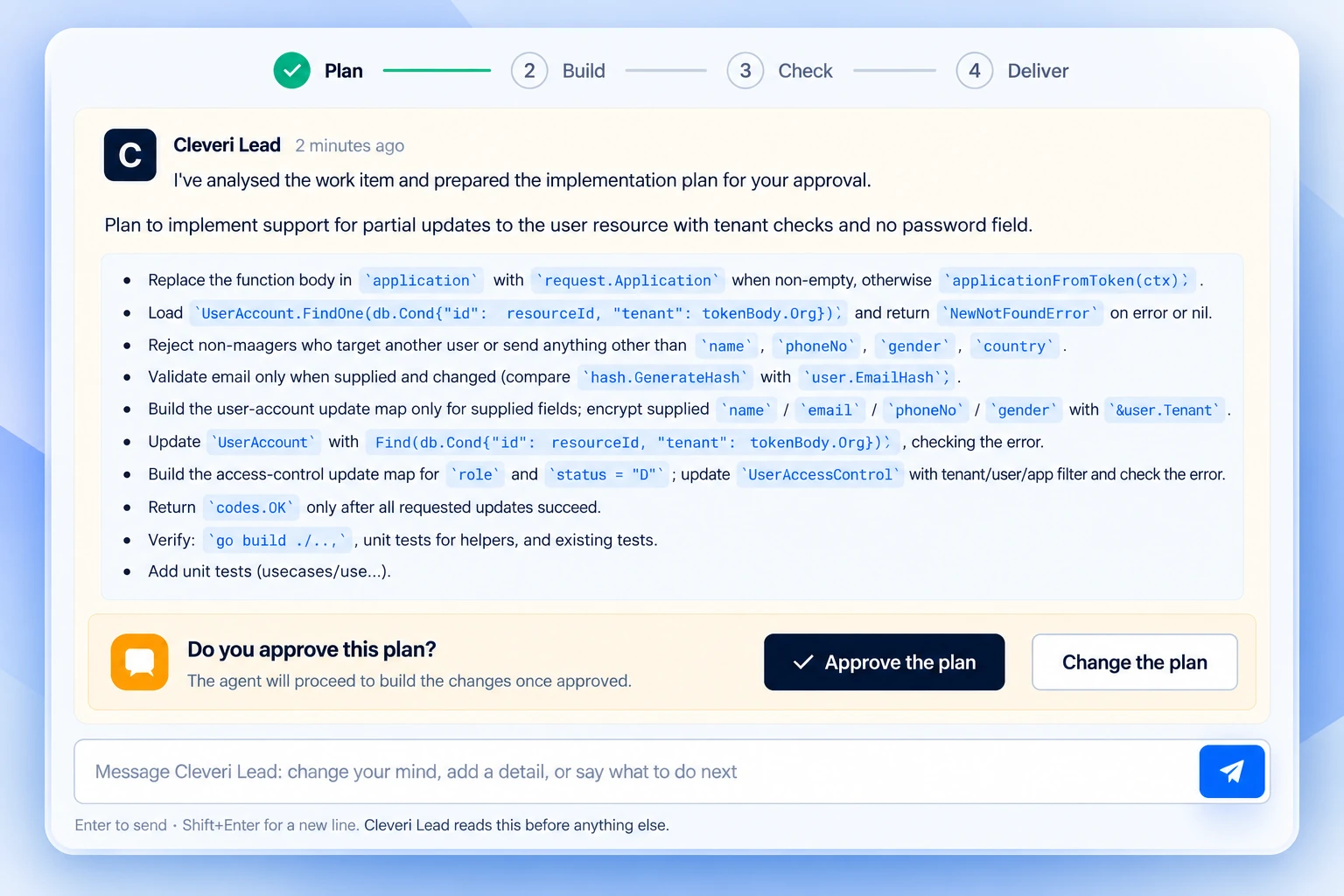
Plan
CleveriReads the work item, investigates the codebase and proposes the engineering approach: what will change, where, and how it will be tested.
- 2
Approve
Your engineerReviews and approves the approach before implementation begins.
- 3
Execute
CleveriWhen a Lane is free, Cleveri implements the approved work in a separate engineering environment.
- 4
Verify
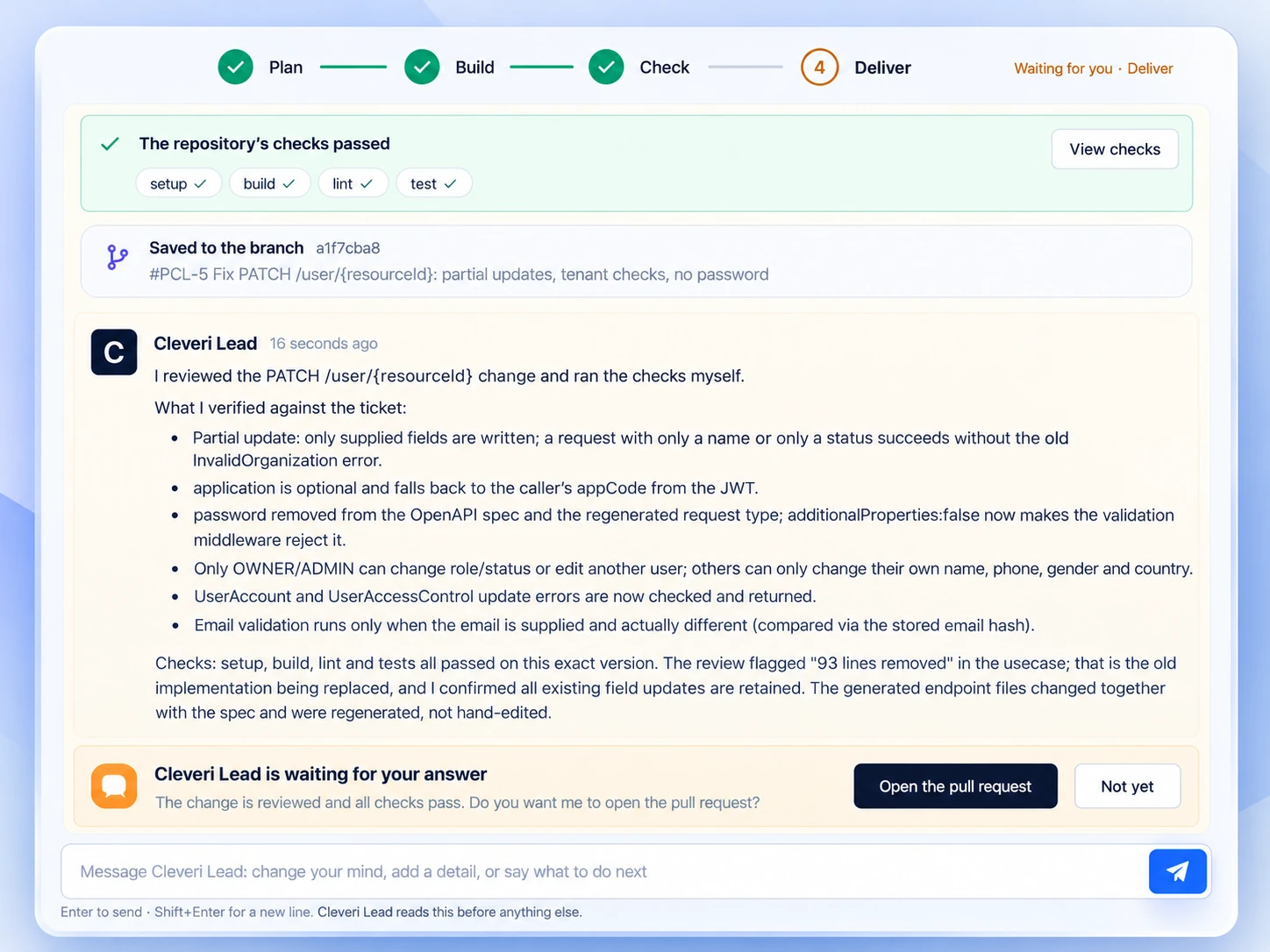
The platformRuns your repository's approved build, tests and checks against the delivered code. The coding agent does not decide whether its own work passed.
- 5
Deliver
Your teamThe branch, pull request and verification results return to your normal QA and review workflow.
Intent stays human. Execution becomes elastic.
Measurable engineering capacity
Know what your engineering capacity produces.
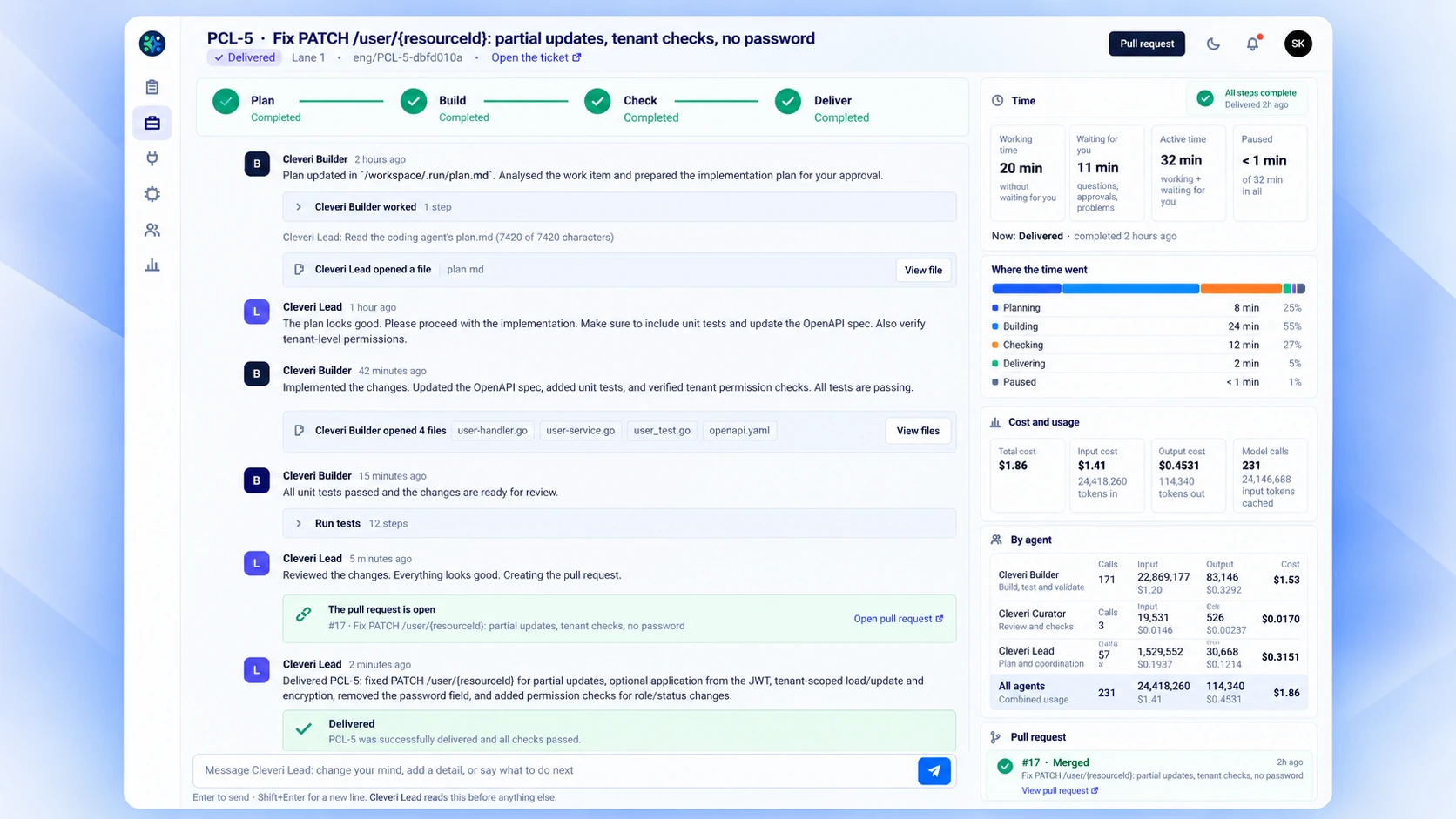
Adding capacity only matters if you can see what it delivers. Cleveri tracks every Engineering Job from approved work to review, giving engineering leaders a clear view of execution, utilisation and outcomes.
See the capacity behind the delivery:
Engineering Credits used — how much active execution the work consumed
Engineering Lane utilisation — how much parallel capacity is being used
Ready-to-PR cycle time — how quickly approved work reaches review
Human supervision — how much engineer involvement was required
Verification results — what builds, tests and checks were completed
AI model cost — model spend kept separate from Cleveri capacity
Measure the outcome, not the activity. A busy agent is not the goal. Accepted engineering work is.
Engineering capacity, redefined
Software delivery no longer has to scale one hire at a time.
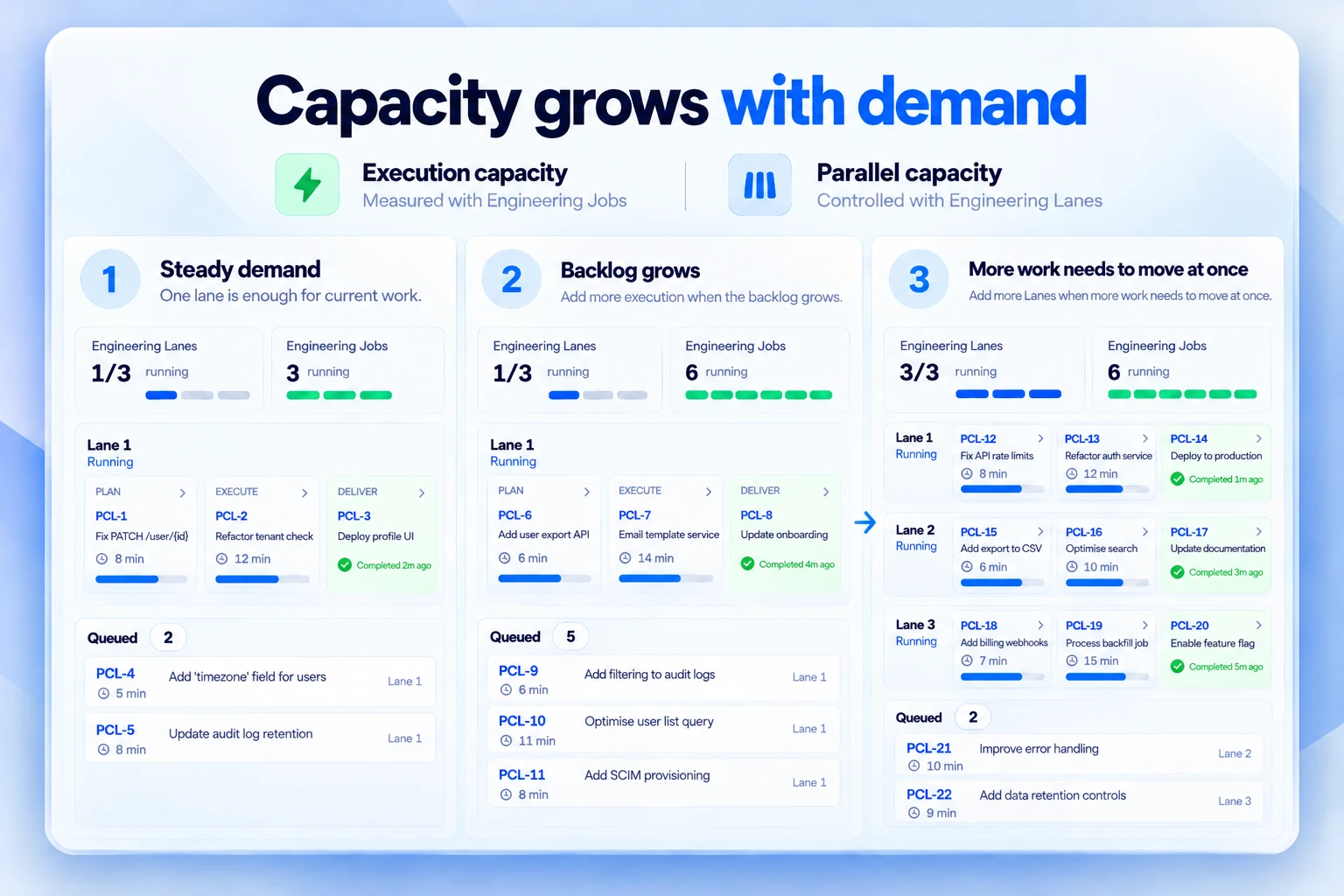
Cleveri separates engineering capacity into two dimensions. Execution capacity, measured with Engineering Credits. Parallel capacity, controlled with Engineering Lanes.
Add more execution when the backlog grows. Add more Lanes when more work needs to move at once.
Coding assistants make individual engineers faster.
Cleveri adds execution capacity to the engineering organisation.
Fits your stack
Work starts where your team already works.
Your work items
Requirements stay where they're already managed.
Your repositories
Changes return through normal branches and merge or pull requests.
Your build and tests
Verification uses the repository's own engineering commands.
Your AI models
Use the providers and models you choose.
The Engineering Capacity Pilot
Prove it on your own backlog.
Before you adopt Cleveri more widely, prove it on one repository and a defined set of development-ready work. Your requirements. Your Tech Lead. Your QA process. Cleveri plans, executes and verifies the work, and the pilot ends with a measured report you can judge on your own terms:
- Pull requests delivered
- First-pass QA acceptance
- Cycle time
- Supervision
- Engineering Credits per accepted change
- AI model cost per accepted change