


Elastic Software Factory
Your backlog in. Review-ready pull requests out.
Cleveri runs delivery as a repeatable line. Your engineers decide at the gates. Cleveri does the execution in between, and adds lanes when the backlog grows.
The delivery line
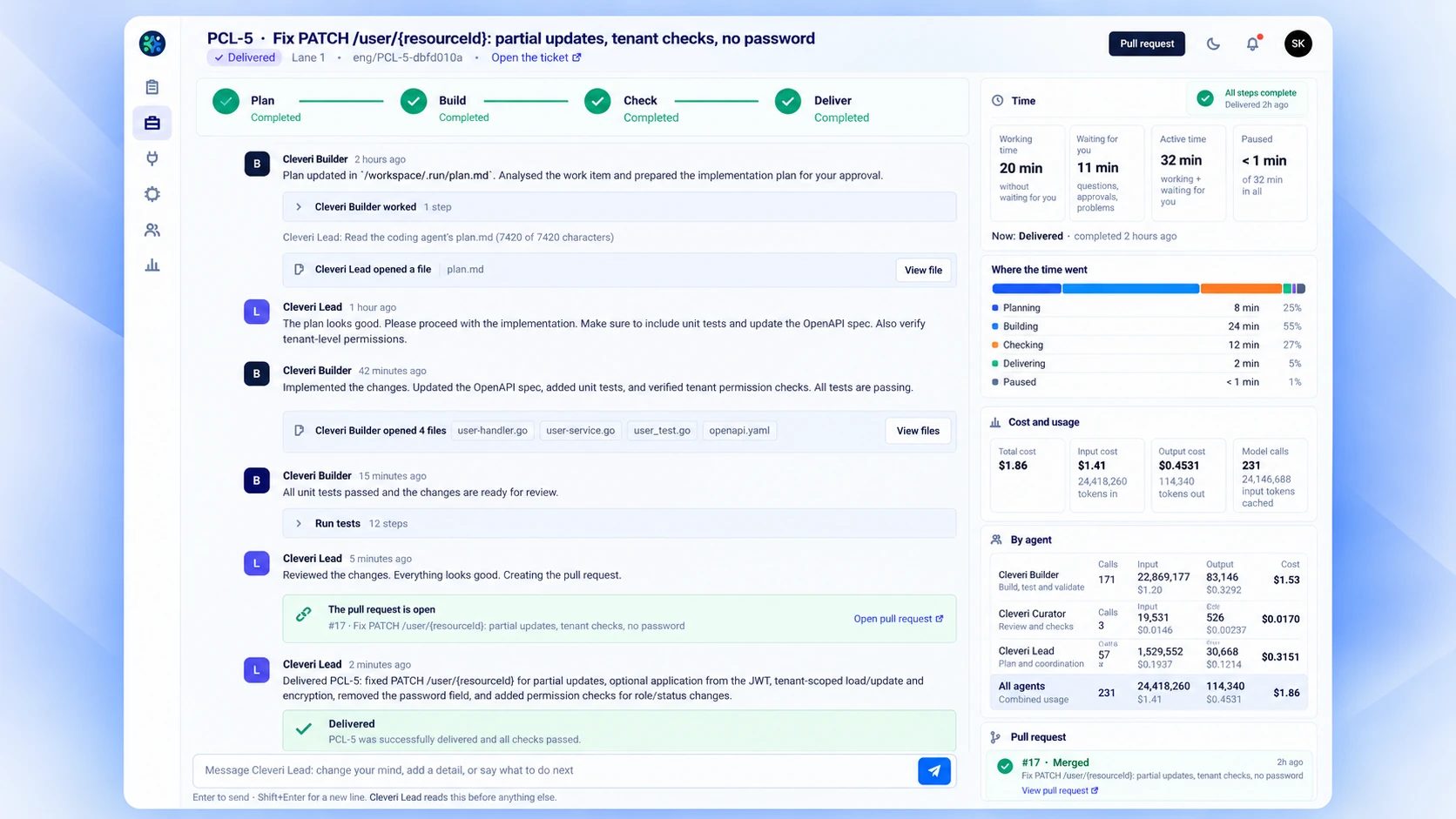
Project lifecycle: one line, end to end.
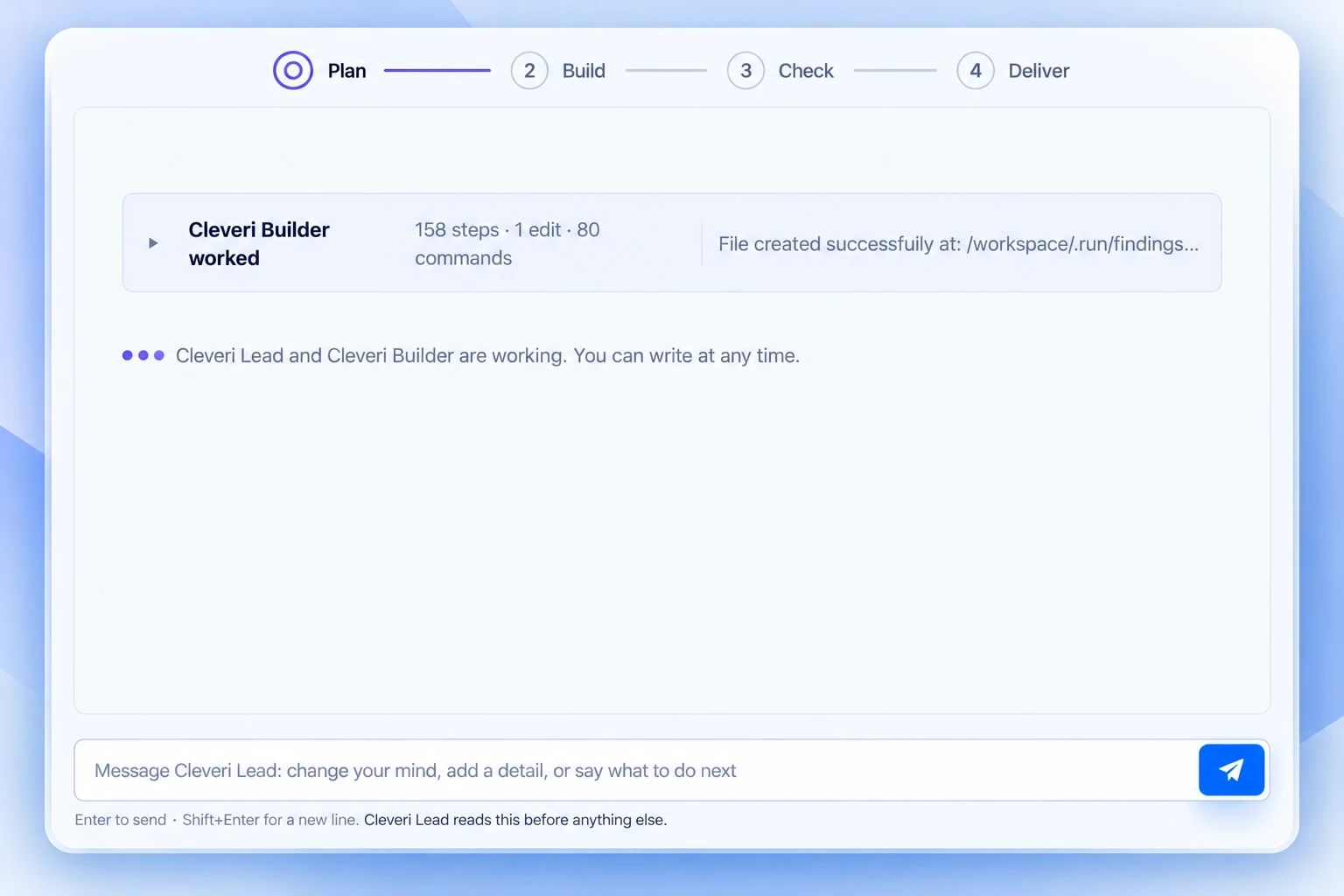
Understand before building.
Cleveri reads the work item, investigates the repository and proposes what changes, where, and how it will be tested.
- Starts from a development-ready item in your tracker
- Grounded in your real codebase
- Pauses for your engineer when the plan is ready
Hands off toApprove
Cleveri and the platform Human decision gate
What a software factory is
Agents run the repeatable middle. People own the edges.
Most delivery time goes into steps that follow the same shape every time: investigate, plan, implement, check, hand over. A software factory turns that shape into a line that runs the same way for every work item.
Define and approve
Choose the work and approve the approach before anything is built.
The repeatable middle
The steps that follow the same shape every time run on the line, in parallel Lanes.
- Investigate
- Plan
- Implement
- Verify
- Rework
Review and merge
Accept the result and decide what merges, in your normal workflow.
- 01
Repeatable
Every work item moves through the same stages, so results do not depend on who set up a session.
5 stages, every Job - 02
Approved before built
Your engineer signs off the approach before implementation starts.
Gate: plan approval - 03
Verified before reviewed
Your repository's own build and tests run before a pull request reaches your reviewers.
Run by the platform - 04
Elastic
Add Engineering Lanes to run more approved work at once. Scale down when the backlog does.
Lanes: 1 to 5+
What the factory runs on
Four building blocks.
- 01Your work tracker
Development-ready work comes in from Jira, where it is already managed.
- 02Engineering Lanes
Each Lane runs one Engineering Job at a time. Three Lanes means three Jobs in parallel; the rest queue.
- 03Gates
Plan approval, platform verification and your own review keep humans in charge of every decision that matters.
- 04Your repositories
Changes return as branches and pull requests, and what Cleveri learns about a repository stays with it for the next Job.
Who does what
Intent stays human. Execution becomes elastic.
- Your engineers
Define and decide
Choose the work, approve the approach, accept the result and merge.
- Cleveri
Plan and execute
Investigate the repository, propose the plan, implement approved work and rework on feedback.
- The platform
Check
Run your build, tests and checks and report what passed, independent of what the agent says.
Scale and standards
Bigger backlogs. Same way of working.
Use one process for every repository and team, then add capacity instead of adding coordination. Try it: the same backlog, with more Lanes.
Same backlog · 8 approved Jobs
- Lane 1PCL-1Fix PATCH /user/{id} partial updates8 min
- Lane 2PCL-2Refactor tenant check12 min
- Lane 3PCL-3Add export to CSV6 min
Queued · 5
- PCL-4
- PCL-5
- PCL-6
- PCL-7
- PCL-8
- Running at once
- 3
- Waiting in queue
- 5
- Credits used while queued
- 0
- Consistent standards
Every Job is planned, approved and verified the same way, and reviewed by your team before it merges.
- Cost and budget control
Engineering Credits meter active work. Business and Enterprise add budgeting controls and bring your own LLM key.
- Your boundary
Run in the Cloud, or self-hosted on Business and Enterprise so code and execution stay in your infrastructure.
FAQ
Questions about the software factory.
How it works, who stays in control, and where to start.
Tell us about your team and your backlog. We will suggest the right next step.
Talk to SalesSelf-hosted